How did a rota problem become a paperwork one?
PROBLEM
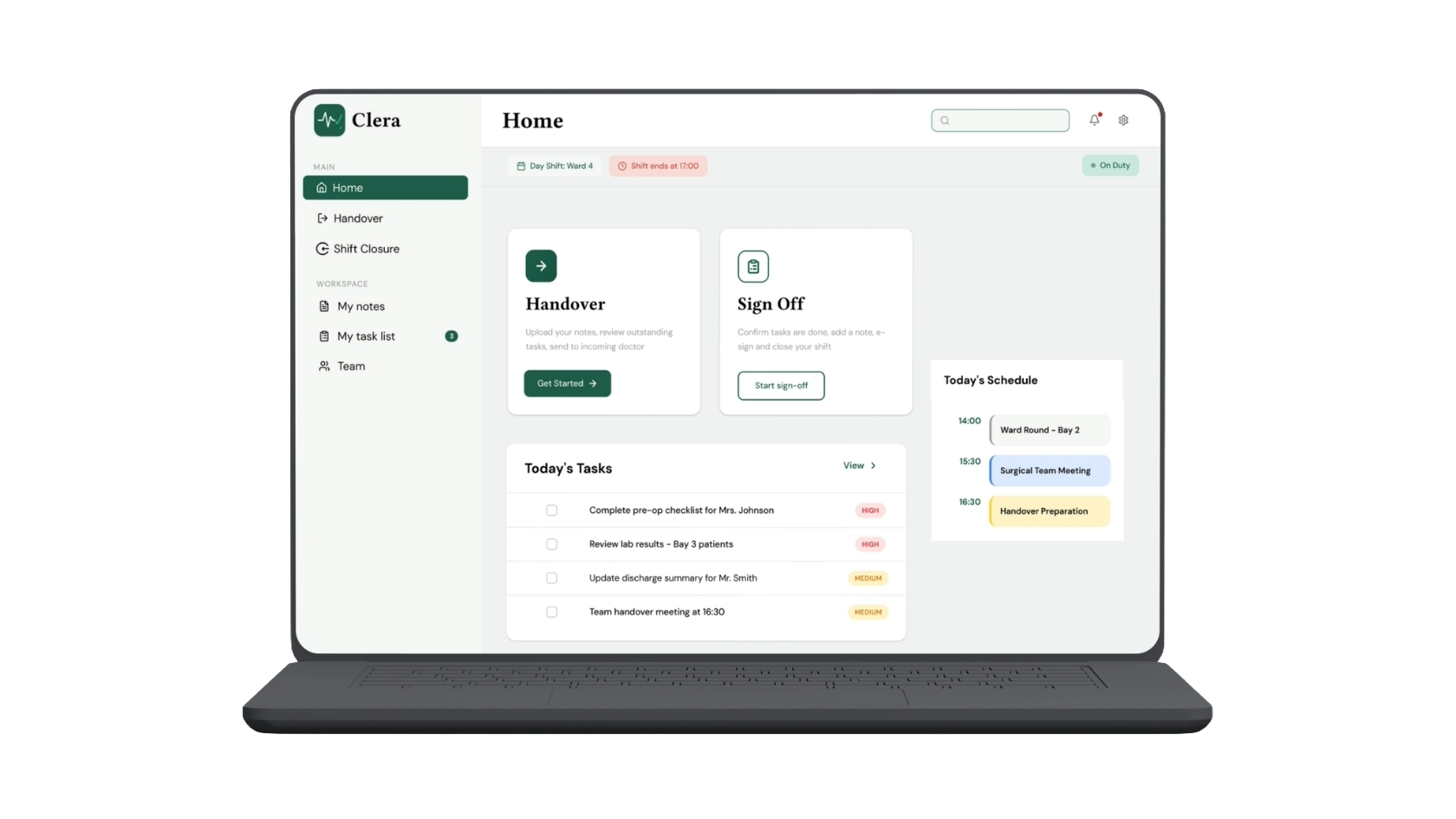
No tool on the market handles end-of-shift paperwork, so clinicians rebuild each handover by hand, 1–1.5 hours at a time.
SOLUTION
Clera auto-drafts an AI SBAR from existing notes for clinician edits, then closes shifts with a checklist, targeting the 1–1.5 hours of reconstruction in a $6.6B market , and no product targets end-of-shift closure.
COMPANY: Clera
CATEGORY: Healthcare, AI Product, Clinical Workflow
MY ROLE: UX Researcher and Product Designer
What’s Really Falling Through the Cracks?
I began by asking where a doctor's time actually goes at the end of a shift. 9 clinician interviews and a 14-clinician survey mapped the process from arrival to going home, surfacing not just how long handover takes, but which part of it carries the weight, and where the original brief had been pointing in the wrong direction.
Have you were wondered why Doctors have a bad work life balance?
Problem
Doctors spend most of their time on administrative work and documentation.
Solution
Clera drafts the handover as the shift happens, turning the 90-minute rebuild reported by 14 clinicians into a two-minute review, which cut documentation time by 51.7% for comparable tools in NHS trials.
Challenges
Paper-based wards, systems that don't talk, and no room for AI to make clinical calls.
Goal
Give the shift a clean endpoint without taking judgment away from the clinician.
Outcomes
Validated MVP flows and a pilot-ready prototype.
THE PROBLEM
Doctors work 2.8 million overtime hours in a year?! What do they actually do?
2.8M
Overtime hours were worked by Irish junior doctors in a single year.
42%
Doctor's day goes to admin rather than patient care
83%
Junior doctors work in contravention of Working Time regulations.
INITIAL HYPOTHESIS
Could smarter scheduling give junior doctors their hours back, or was the rota the wrong place to look?
The research says something else…..
I interviewed 9 clinicians across geriatrics, respiratory, neurology and surgical specialities in the UK and Ireland about what their day looks like and where they spend most of their time, to validate the initial hypothesis that their rota system isn’t efficient enough to allow them to work.
Theme: Time consuming tasks
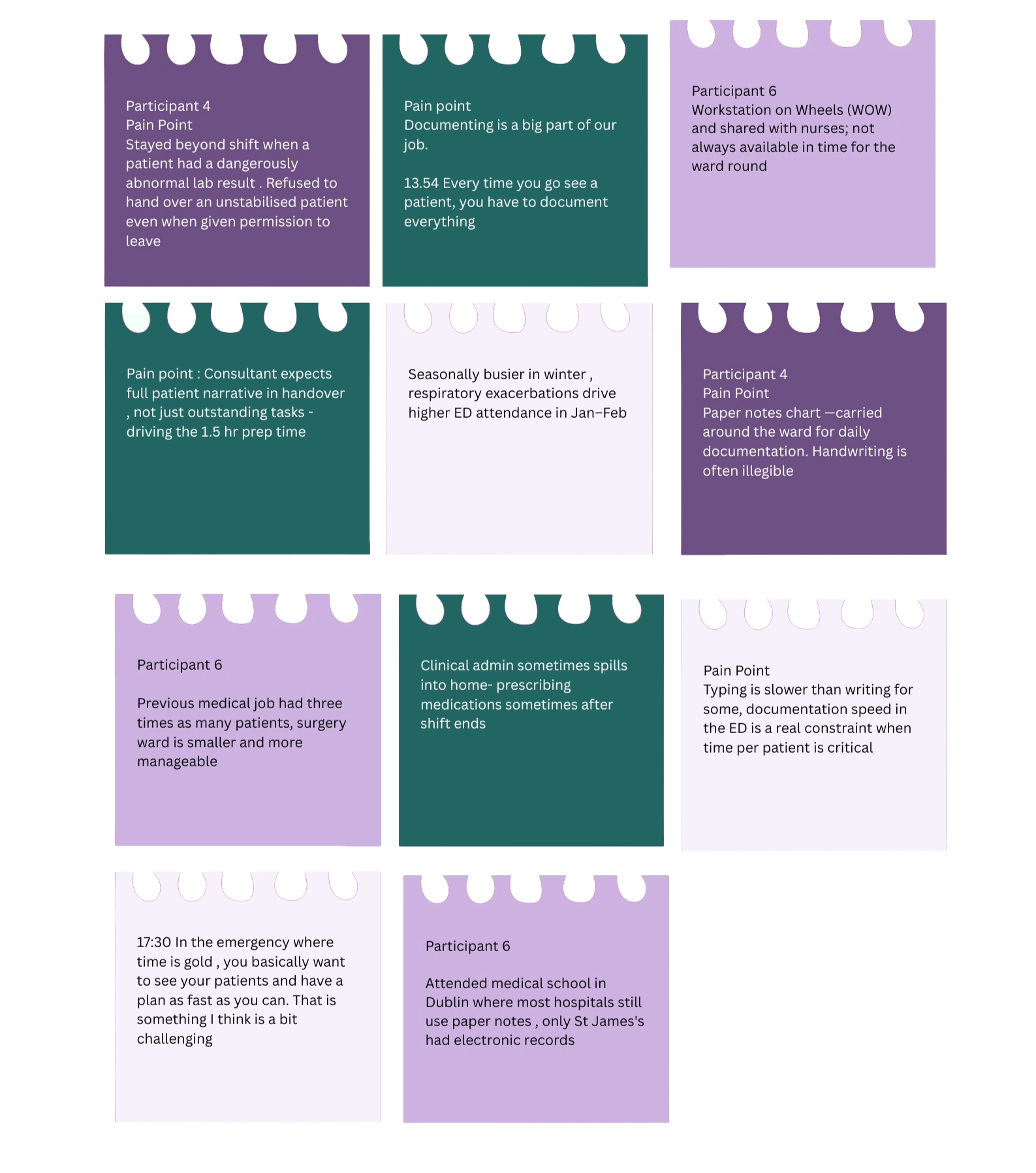
Theme: Workoholic traits
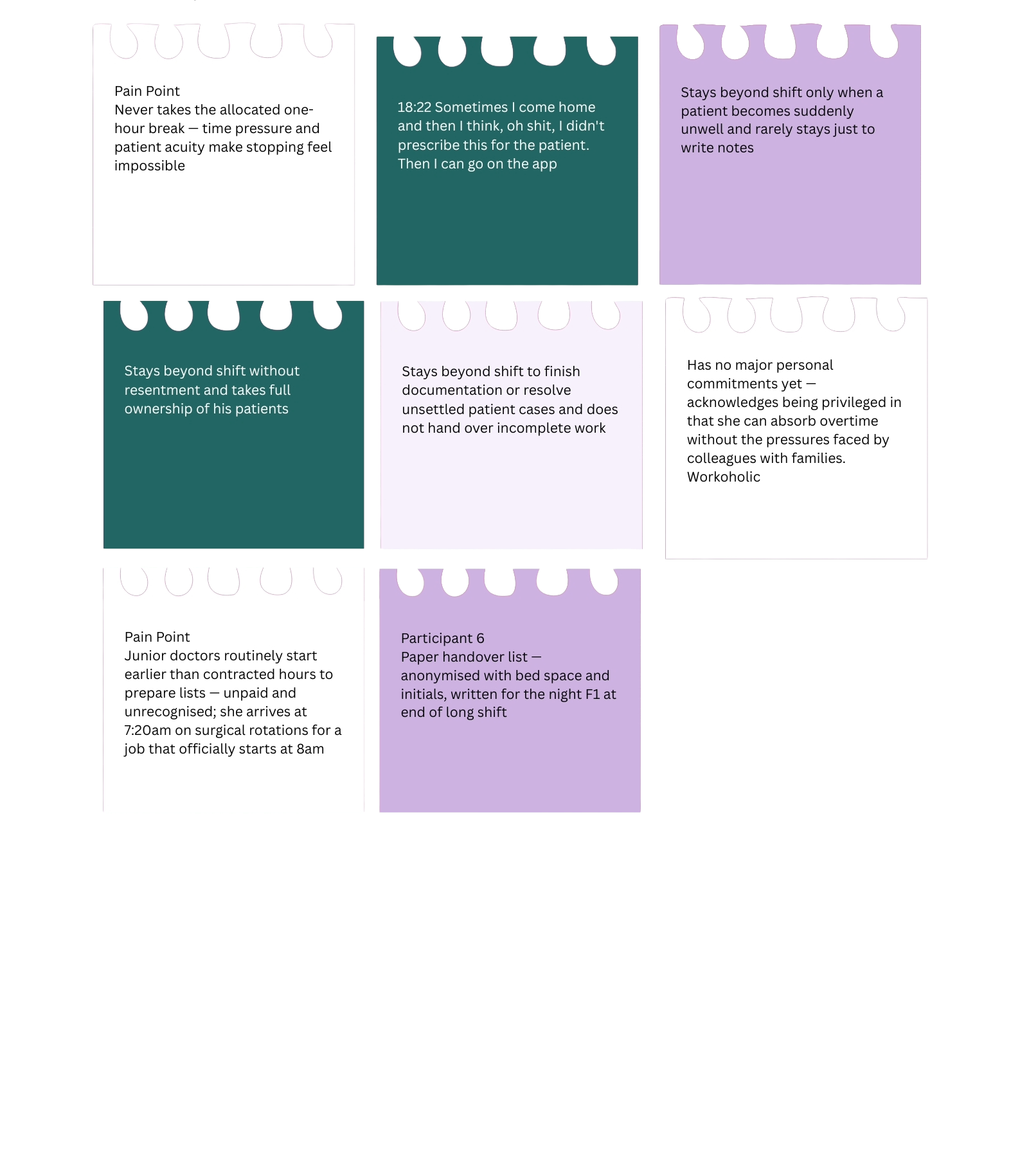
Theme: Handover burden
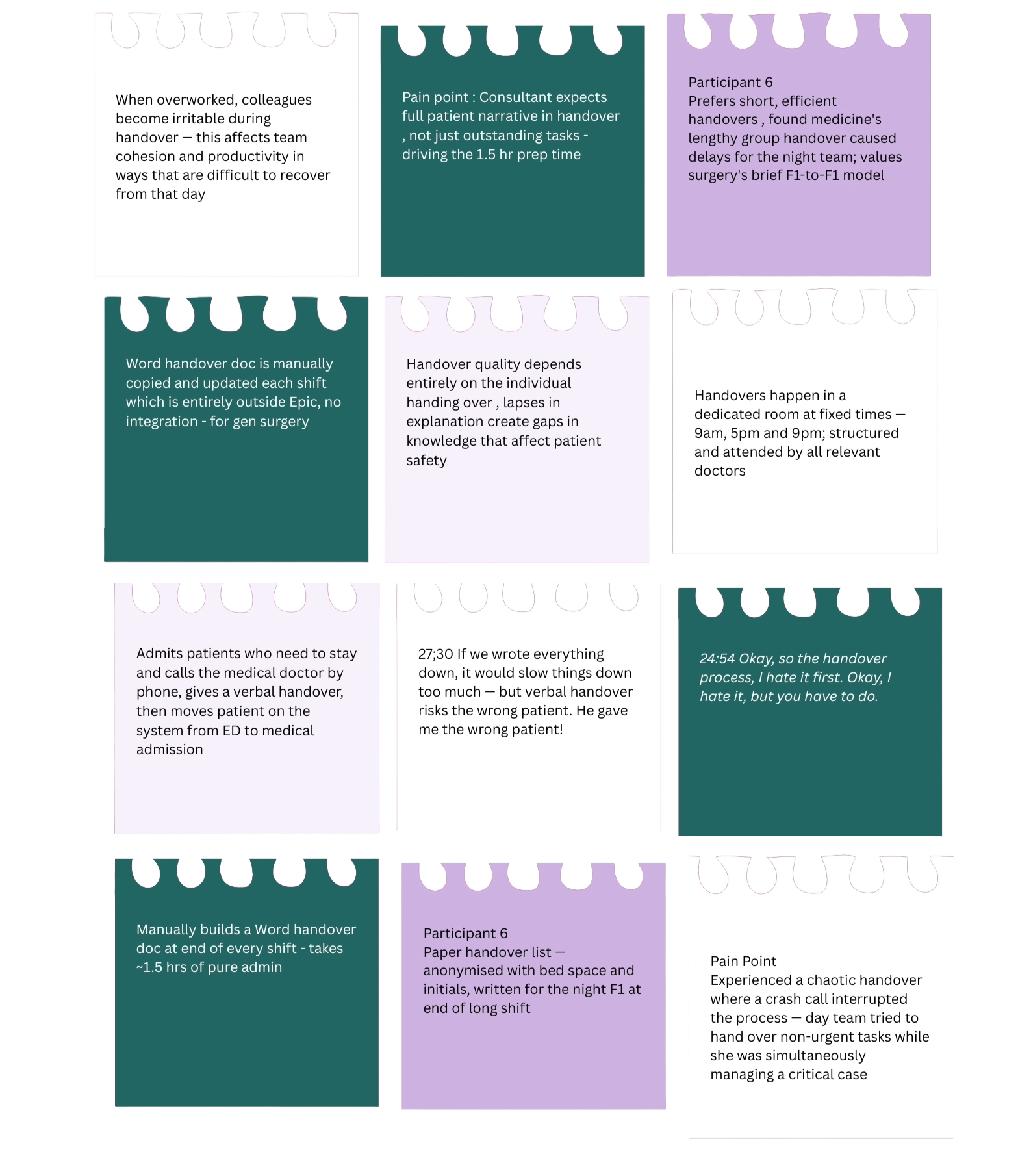
Discovery interviews revealed deeper root causes shown by the affinity clusters. Rota management was only a symptom.
We came for the rota. We found more paperwork.
After reviewing all survey and discovery interview findings, we identified these key insights.
THE ACTUAL PROBLEM
How might we help doctors close their shift within contracted hours, rather than after them?
"Show up every day at 7:20. Leave every day at 6:37. Don't get paid for overtime."
Invisible Problem
1
The Synthesis Burden
How might we remove the reconstruction work that happens before a handover can even begin?
"I spent an hour and a half. Literally an hour and a half. Just preparing for handover."
2
Admin Over Medicine
How might we return clinical time to clinicians?
"If we wrote everything down, it slows down everything."
3
How might we give clinicians permission to mentally let go at the end of a shift?
"Sometimes you go home with it. Did I do all I could?"
Emotional Carry Over
4
Handover work spills past the end of a shift, unpaid and largely invisible.
USER JOURNEY
The goal shifted from rota to handover as discovery interviews surfaced the real bottleneck
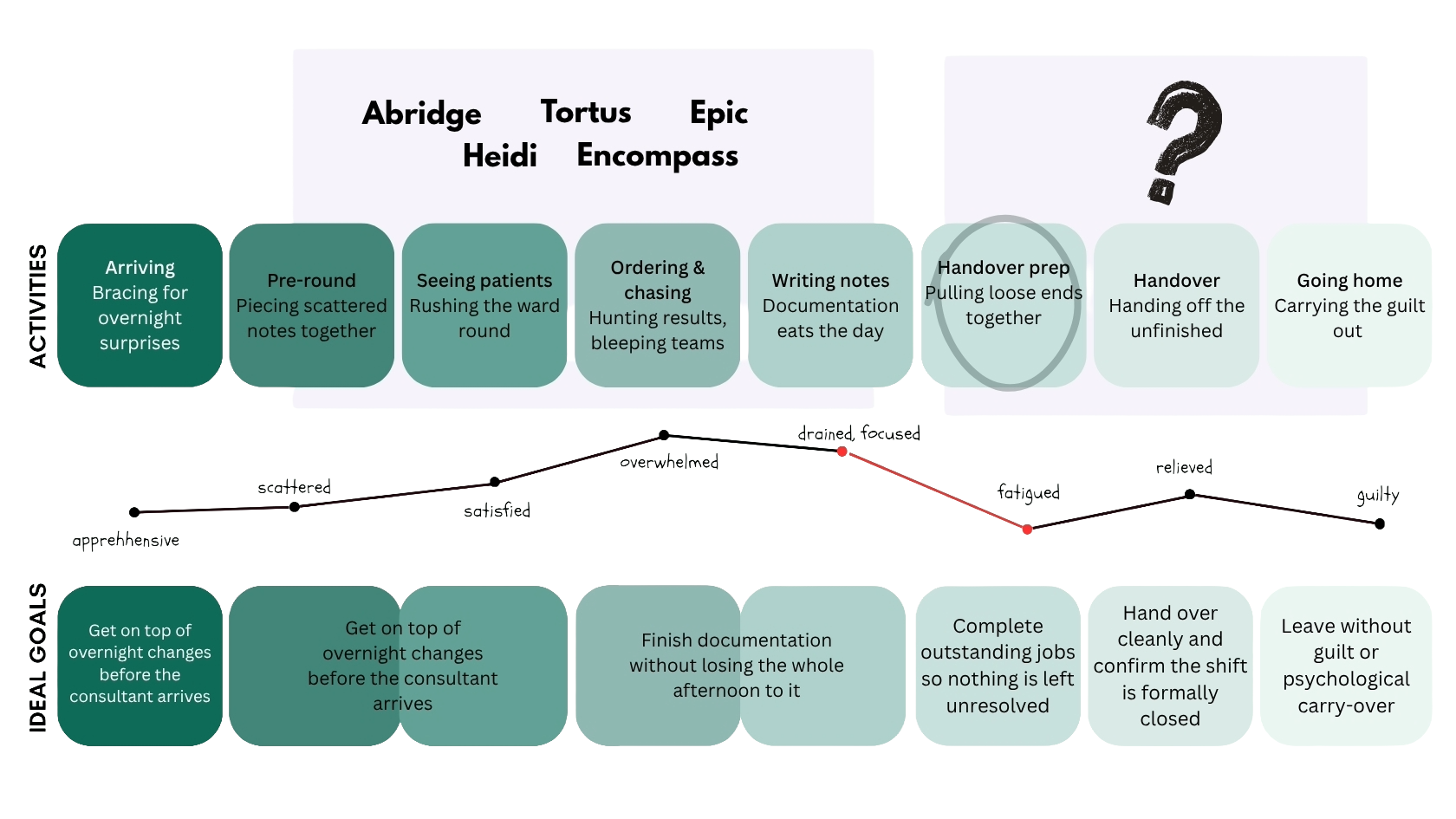
Mapping Dr M’s shift end-to-end showed where the effort actually concentrates. Energy holds steady through ward rounds and reviews, then drops sharply at handover, the phase they have to reconstruct from scratch, and they are fatigued, often after their shift has technically ended. The journey map identified the problem, which further supported the findings of the interviews.
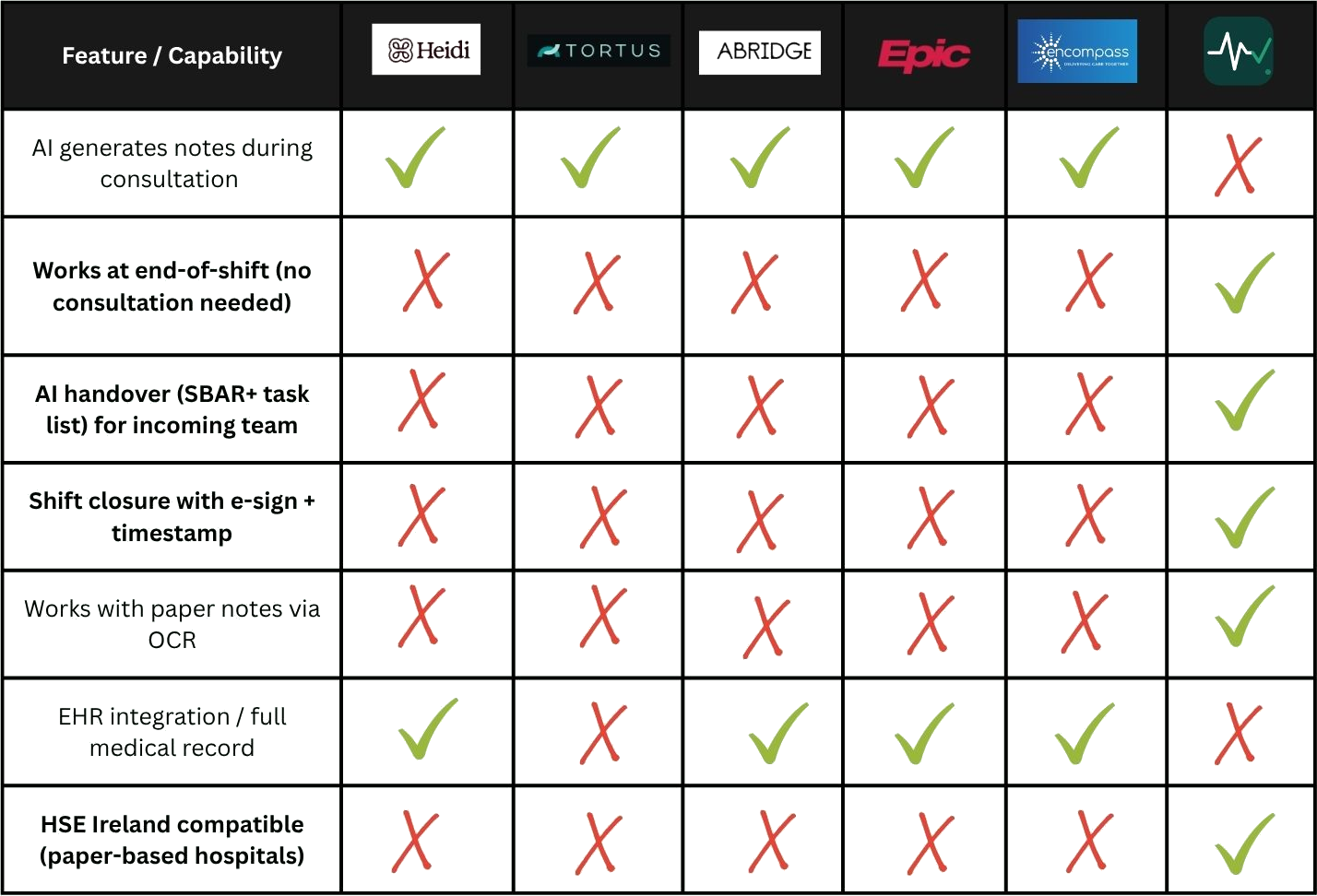
Most existing tools treat documentation as a consultation-time problem: ambient scribes, dictation, note generation during the patient encounter.
None address the end of the shift, where the burden actually lands.
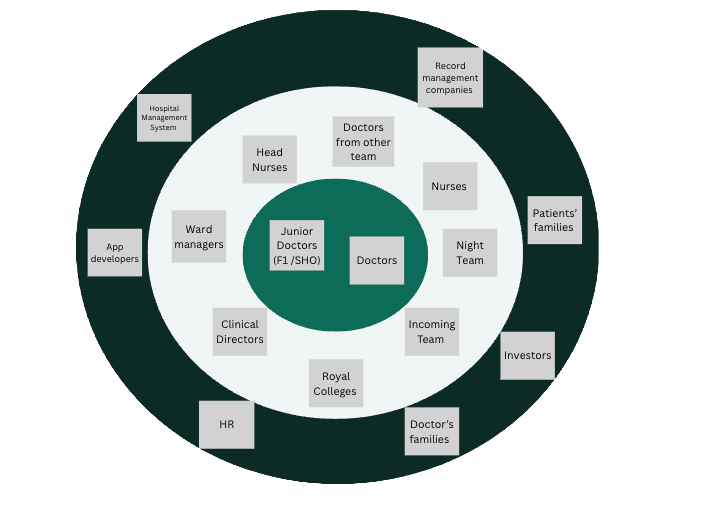
Who is impacted by this issue ? Whom do we design for?
The design centres on the doctor- every choice starts with their workflow. Surrounding that are:
(1) nurses, care coordinators, and patients who experience daily impact
(2) administrators, hospital systems, and regulators focused on cost, compliance, and outcome
Keeping the doctor central ensures the product supports the wider ecosystem.
-
![A four-quadrant chart comparing AI integration in healthcare. Top-left: traditional roles, hands-off to doctors, not AI-focused. Top-right: prescribes remotely via apps, uses AI efficiently, prefers AI for summaries. Bottom-left: strict ward routines, cautious AI adoption, emphasizes traditional procedures. Bottom-right: innovative, patient-centered, open to AI for discharge planning, early patient catch-up, and AI use in inpatient care.]()
Iteration 1
-
![A four-quadrant chart comparing AI stakeholders' views. Top left: Sees documentation as a clinical problem and warns AI cannot carry legal responsibility; labeled 'Protectionist.' Top right: Values detailed notes, wants AI to handle handover; labeled 'Integrators.' Bottom left: Notes are learning tools, cautious about AI shortcuts; labeled 'Traditionalists.' Bottom right: Discharge summaries, concerned with AI adoption; labeled 'Desperate Adopters.' The axes are labeled 'Admin Work = Most painful' and 'Low Openness to AI' versus 'High Openness to AI'.]()
Iteration 2
-
![Diagram contrasting trust in AI based on external validation versus personal experience, with sections on gatekeepers and radicals, and notes on AI development and approval.]()
Final Iteration
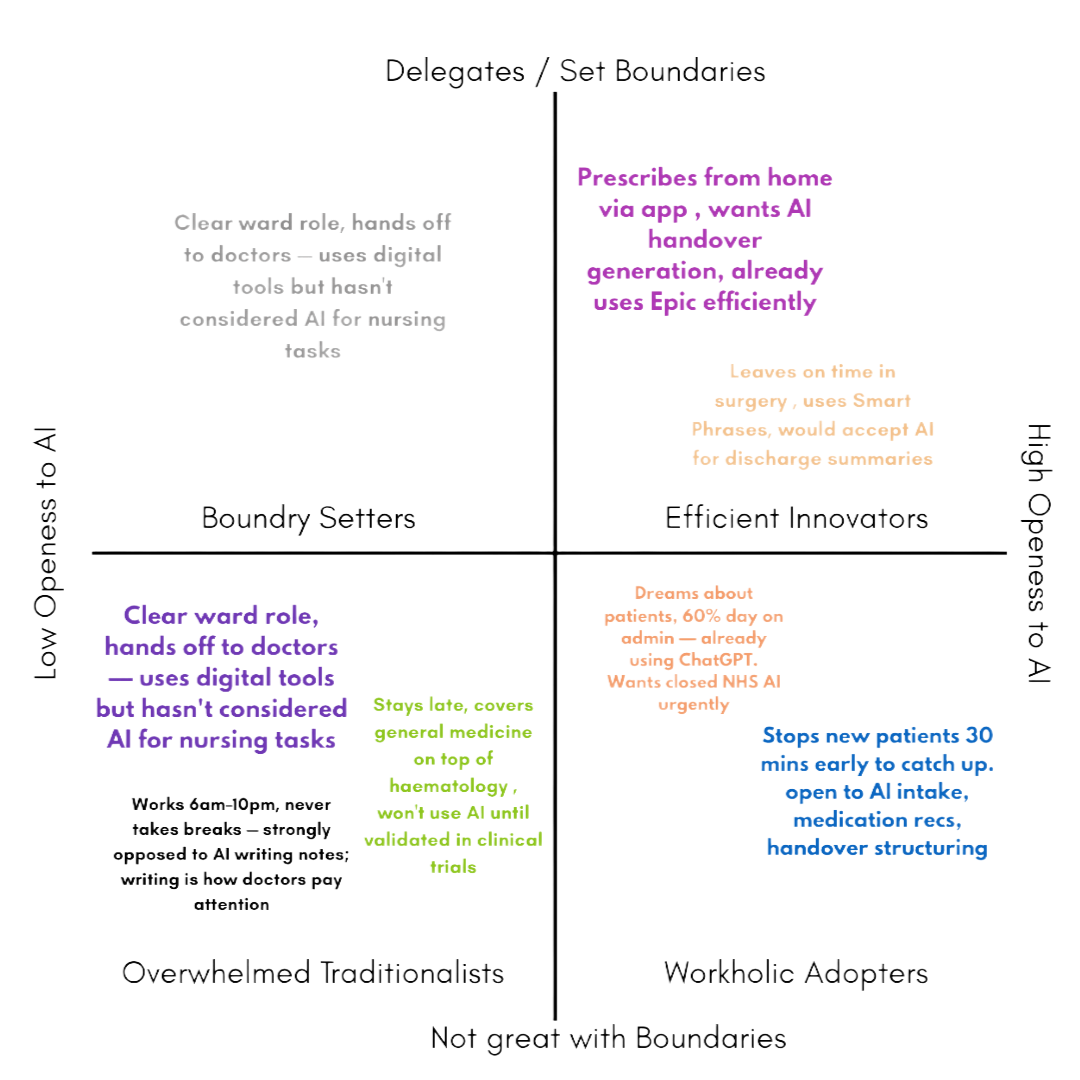
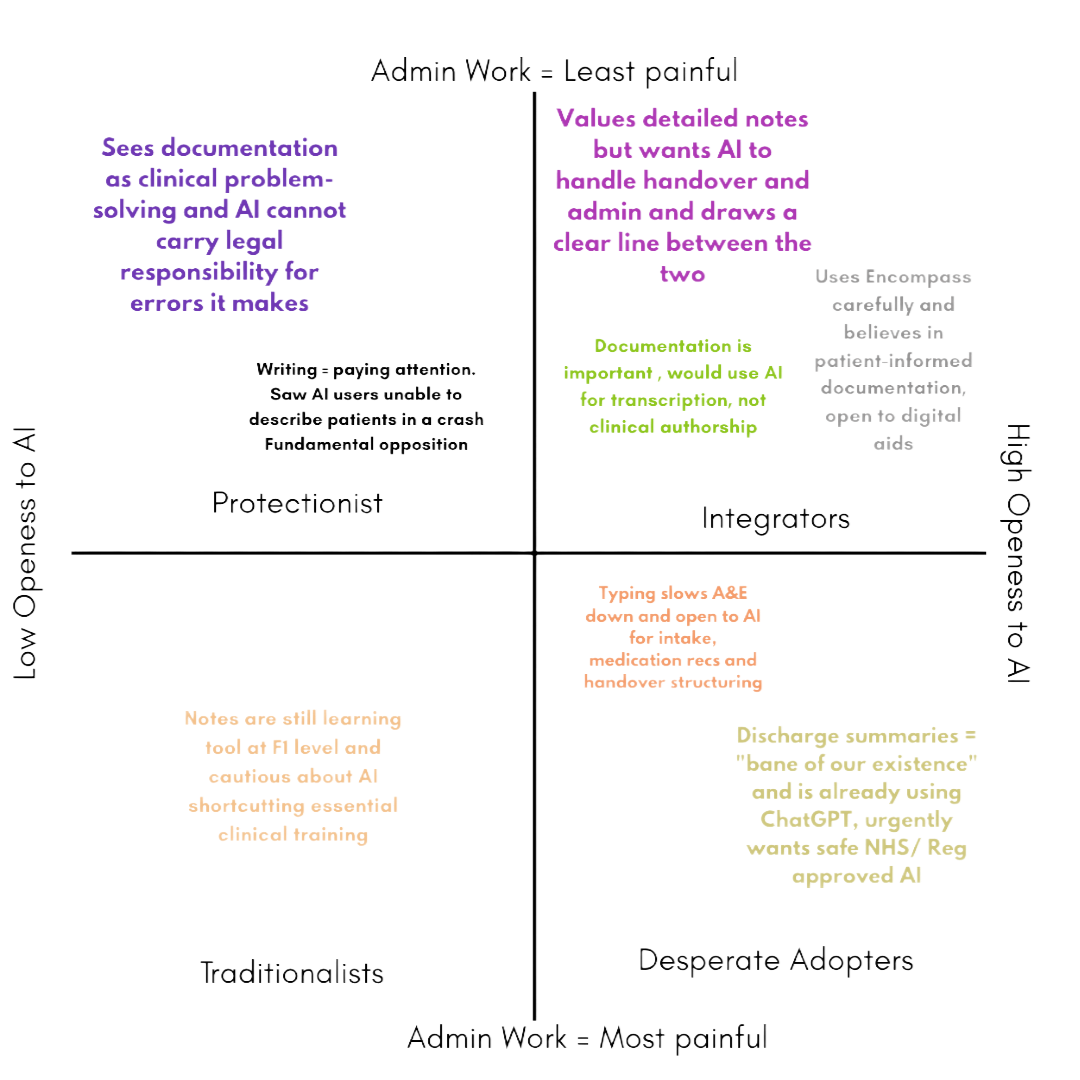
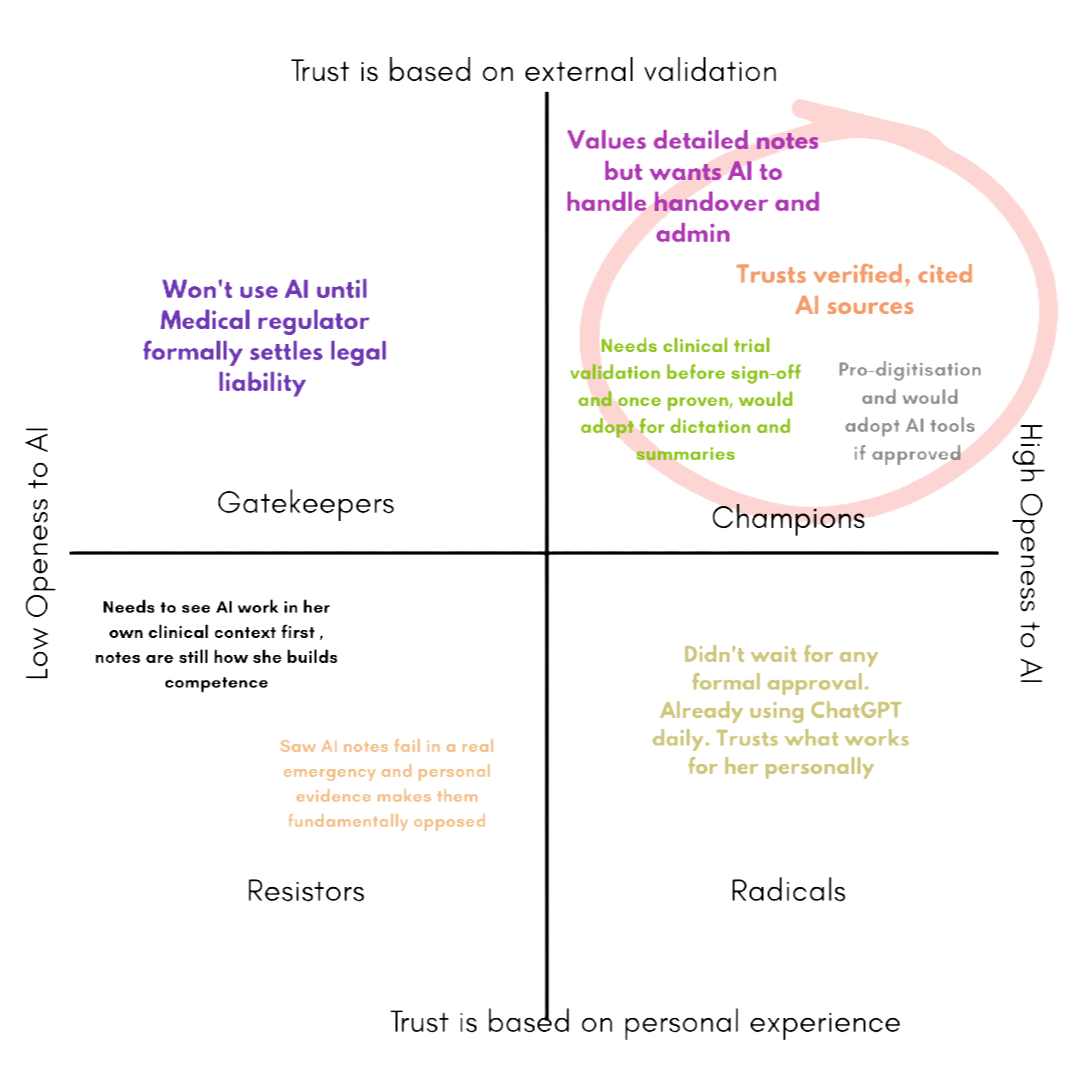
We narrowed the segments to doctors who are open to AI and who validate solutions externally, willing to use other apps/tools beyond prescribed workflows. This trait marked Champion adopters.
Using Insights to develop a Solution: Clera
Clera is a handover and shift-closure tool built for clinicians working across paper and digital systems.
It combines :
AI-generated SBAR ((Situation, Background, Assessment and Response) handovers from existing notes
OCR upload for paper and Word documents
Priority triage for the incoming team
Timestamped shift closure with e-signature
Clera helps healthcare workers:
Hand over without rebuilding the day from memory
Surface critical tasks rather than burying them in a list
Resume an interrupted handover across sessions
Close the shift formally and leave
Not having a half-baked prototype. Why is defining your MVP important?
Warm intentions, a lot of flour, and zero usable pastry?
A product without a clear MVP is like a baker handing you a lump of buttery dough with googly eyes and a sticky note that reads “croissant”.
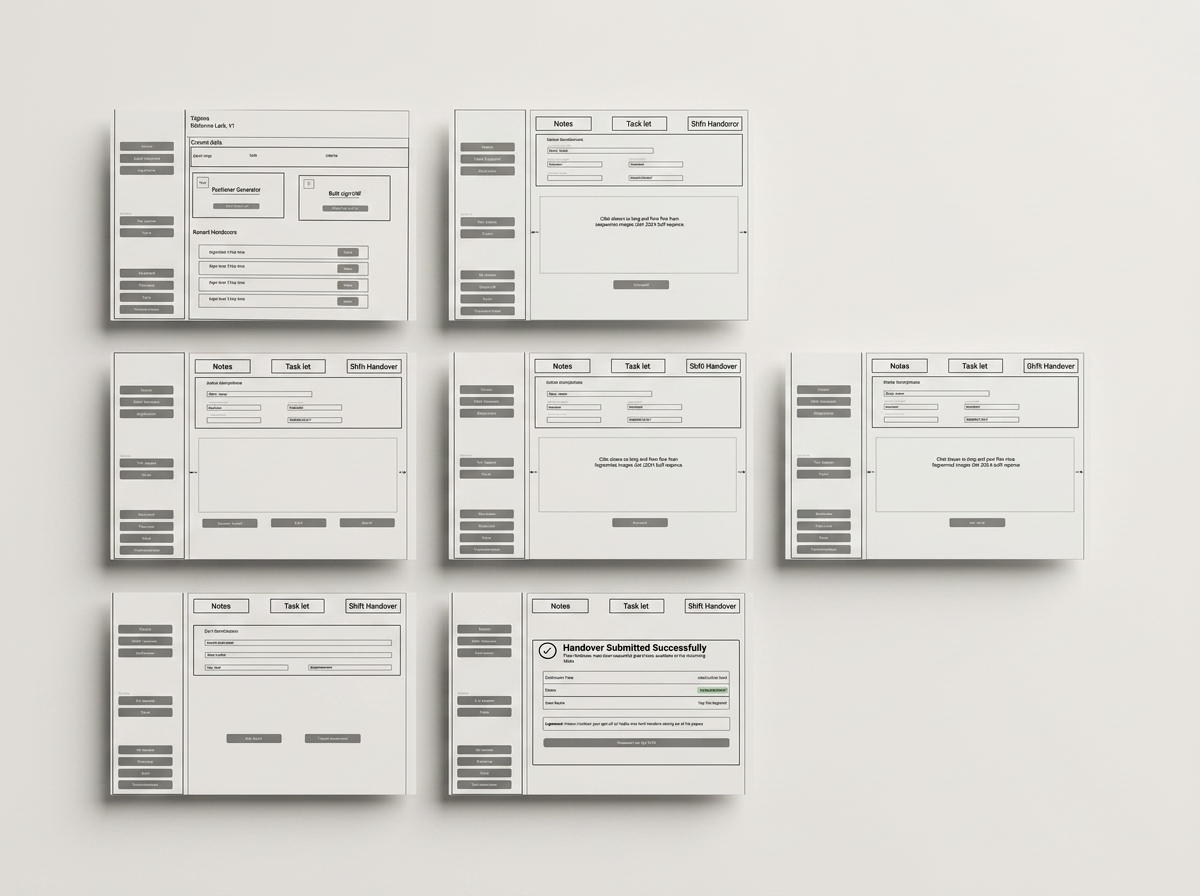
The aim was to convert insights and reach into an MVP that defines Clera: a focused, usable product that embodies Clera’s unique value and identity. The MVP focuses on two core moments: generating the handover and closing the shift. To support those moments, the design includes a home dashboard and task management.
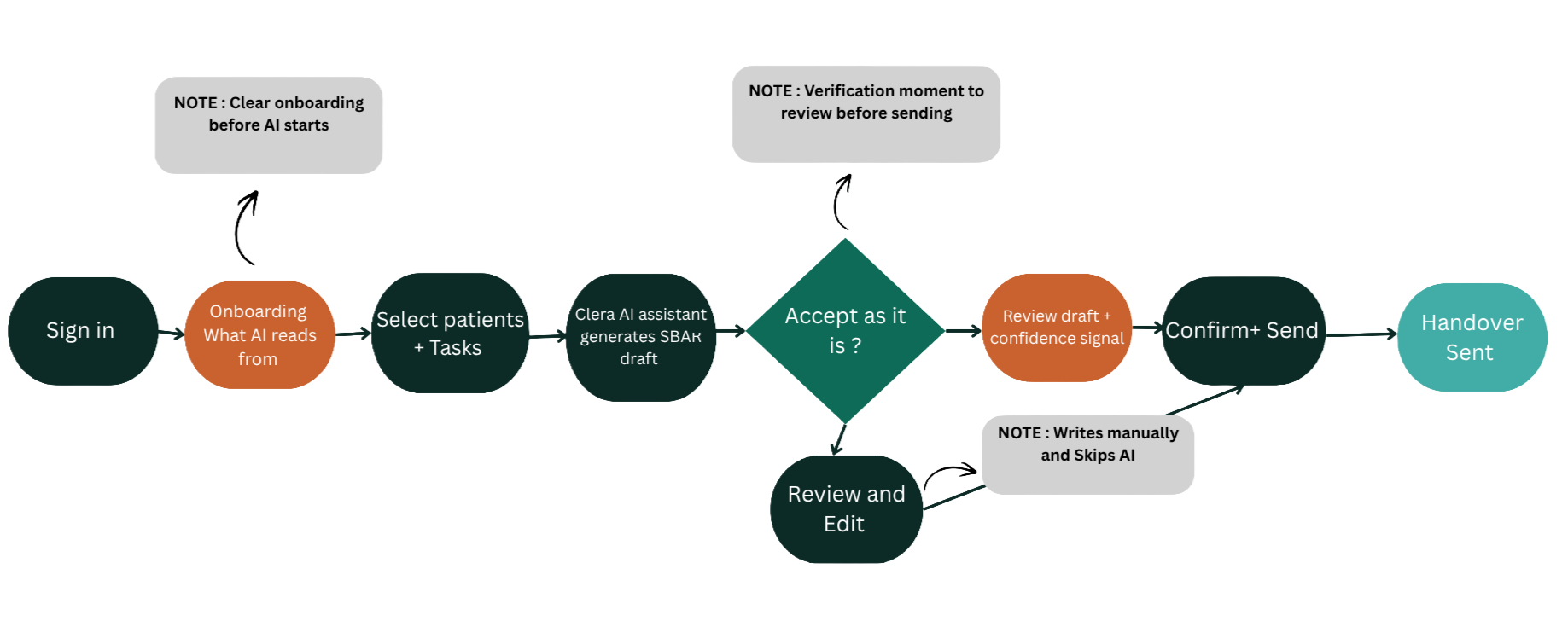
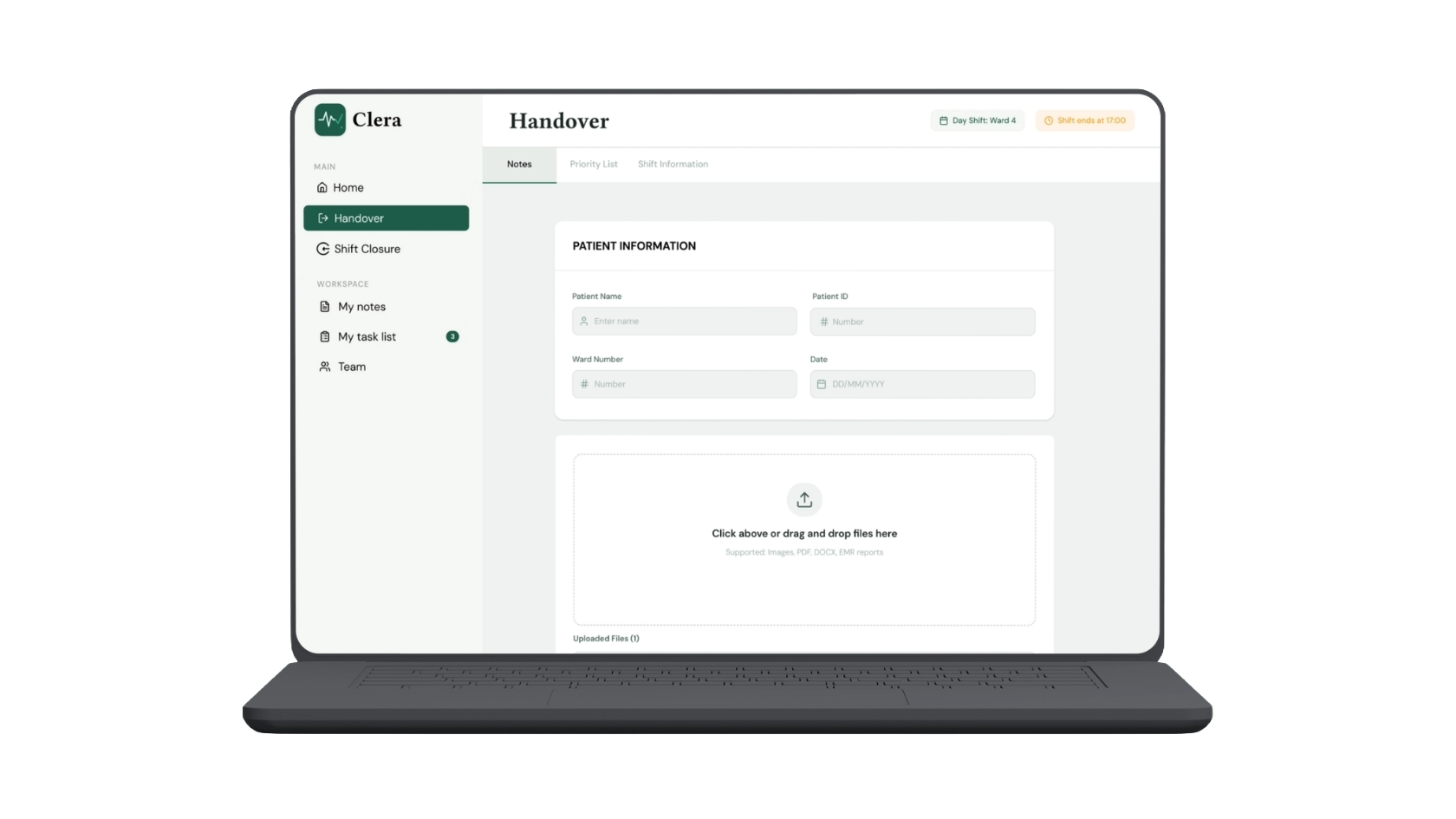
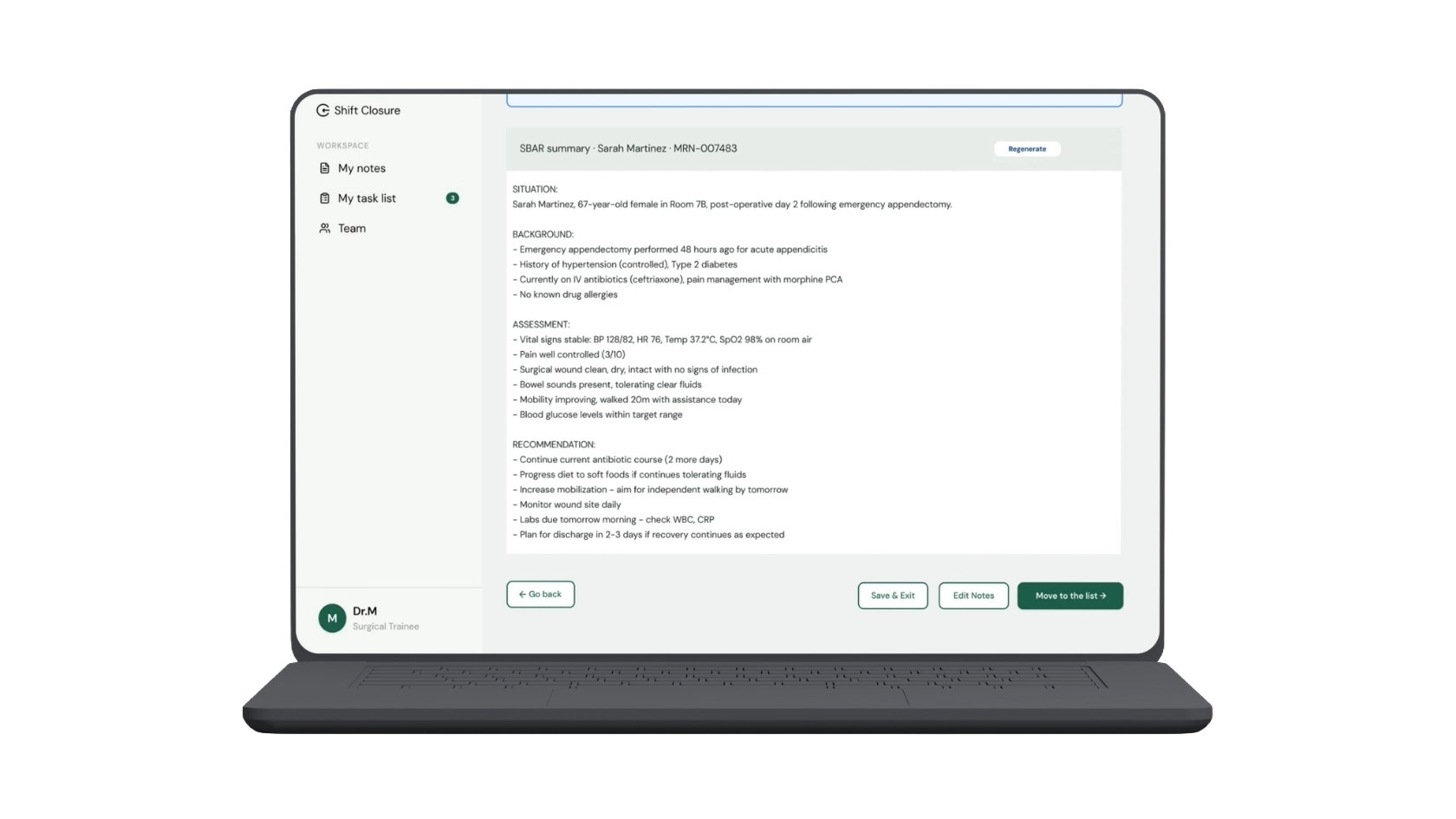
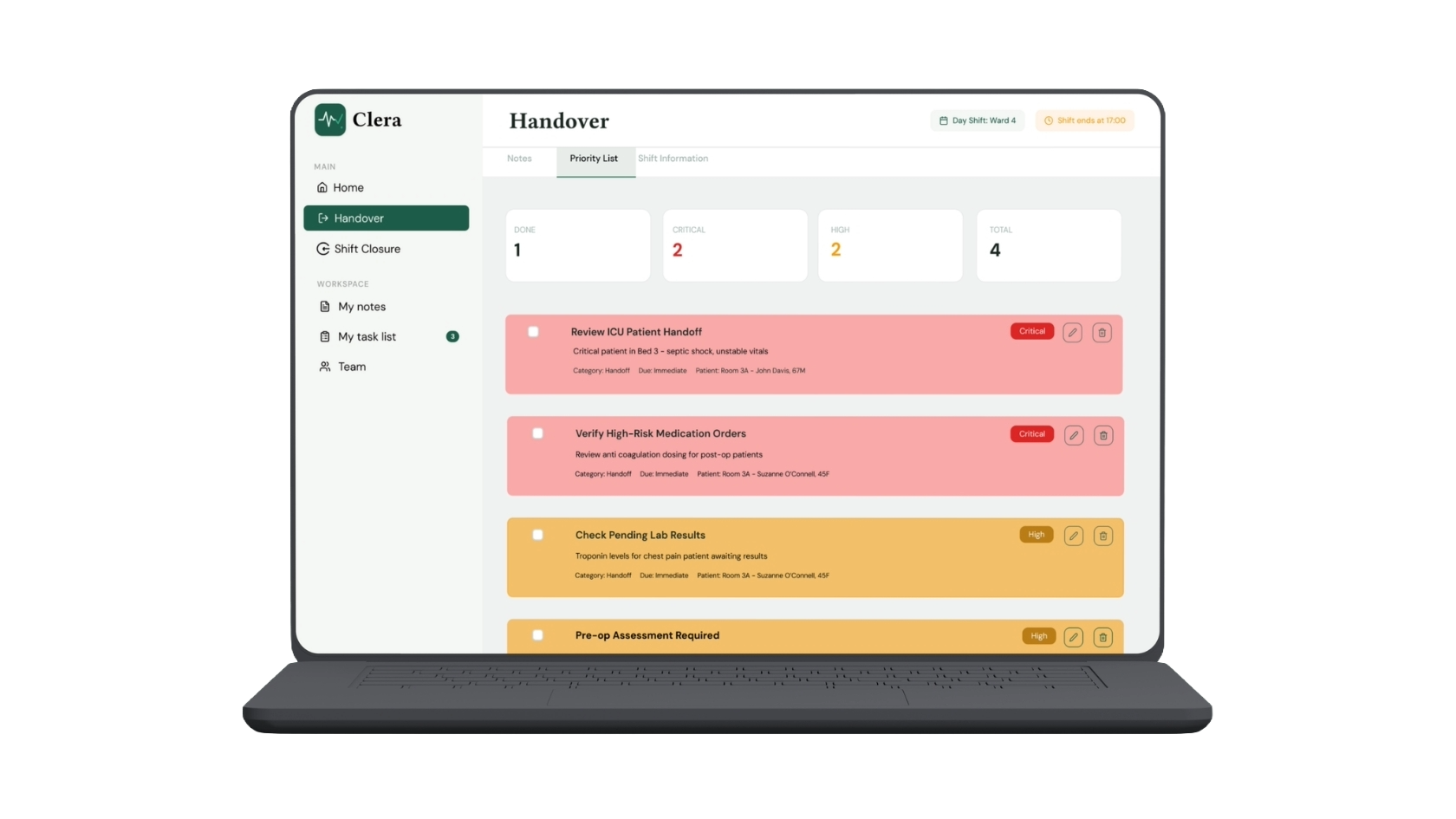
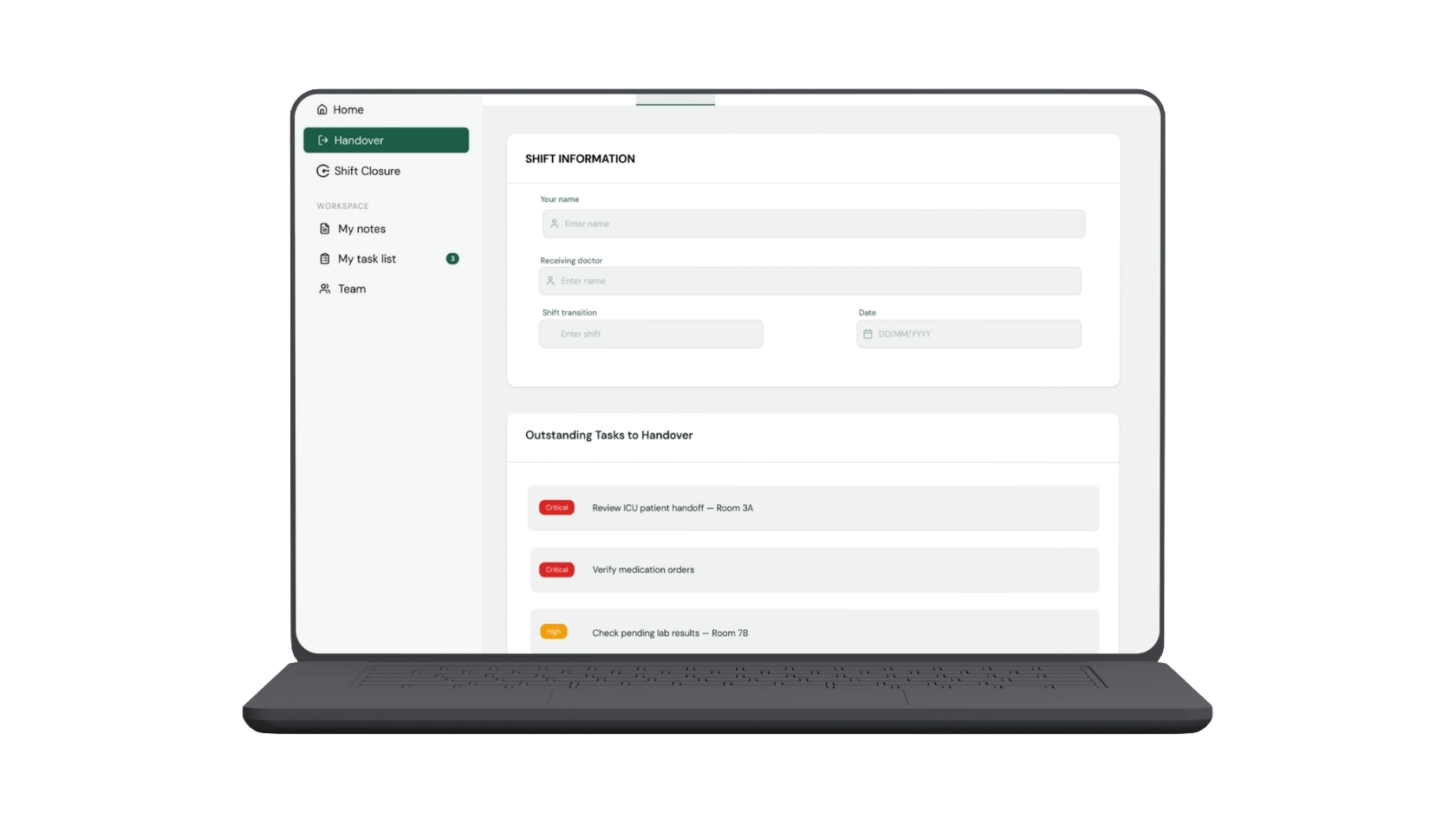
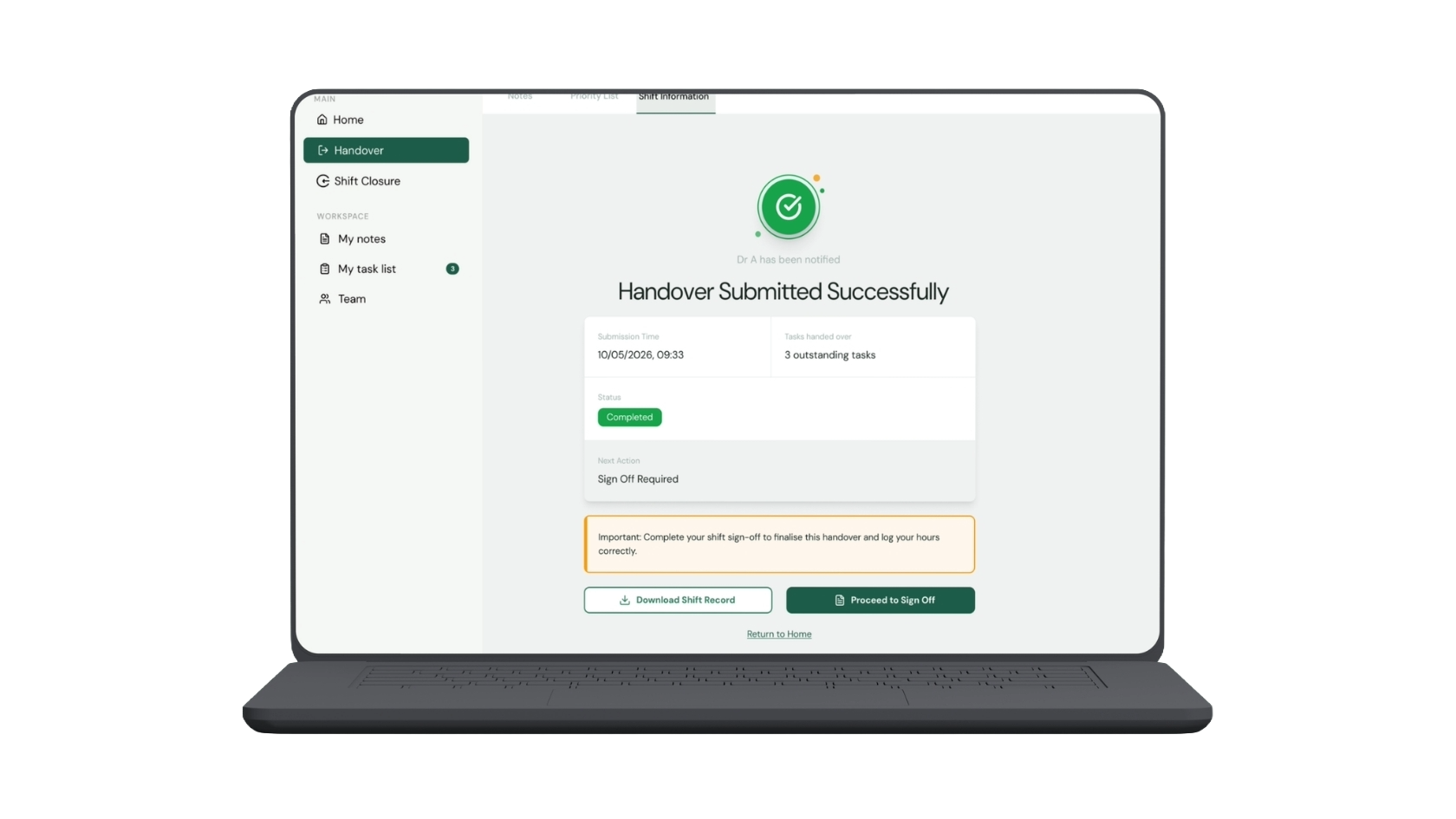
Clera simplifies the process of the Handover flow by selecting patients and tasks. AI generates the SBAR draft; Doctors can review and edit it or accept it as-is, confirm and send.
WIREFRAMES
The path wasn’t straight forward….
Low-fidelity wireframes focused on information hierarchy, reducing cognitive load at the point of fatigue, and making the verification moment unmissable before moving into visual design.
Designing for the moment nobody owns
The most useful thing this project did was disprove its own starting point. I began with a scheduling hypothesis because it was the obvious one; over time, it looks like a rota problem until you sit with someone who works one. Nine interviews in, the rota had stopped being interesting, and the paperwork had become impossible to ignore.
What I'd do differently is get to the process map sooner. I spent time early on testing a hypothesis that the participants themselves could have dismantled in the first conversation, had I asked a more open question about where the shift actually goes.
The wider lesson is that the loudest complaint isn't always the real constraint. Clinicians talked about hours because hours are what gets measured; the reconstruction work hiding inside those hours had no name, no metric, and no owner, which is exactly why it survived so long.
REFLECTIONS